
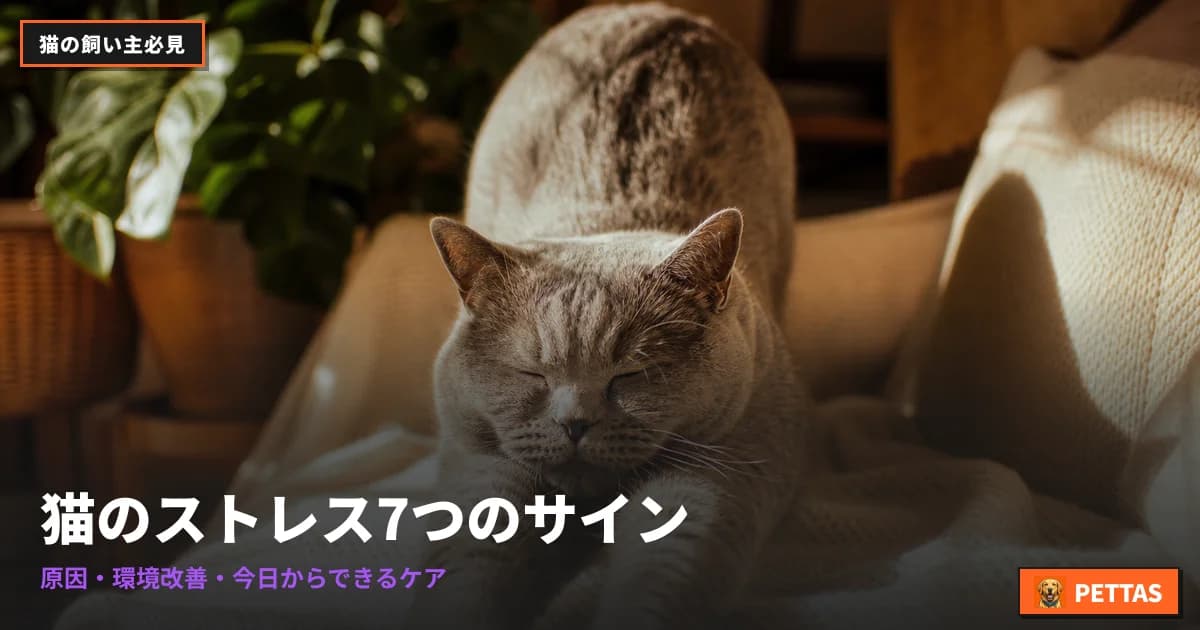
7 Cat Stress Signs Owners Miss: Vet-Approved Fixes (2026)

PETTAS Editorial Team
Up-to-date pet health guidance
Nearly 50% of indoor cats show chronic stress. Spot 7 hidden warning signs, find the causes, and fix your cat's environment today. Full checklist inside.
Contents(8)
Last updated: 2026-05-29
Does your cat seem "off" lately but you can't quite put your finger on why? Cats are masters at hiding discomfort, which means stress often goes unnoticed until it becomes a serious problem.
According to the American College of Veterinary Behaviorists, an estimated 40-50% of indoor cats experience some degree of chronic stress. That means roughly 1 in 2 cats living exclusively indoors may be struggling -- even if they look perfectly fine to you.
This guide covers 7 stress signals that owners commonly overlook, the most common causes (especially during warmer months), and practical steps you can take today to improve your cat's environment.
7 Cat Stress Signs You Might Be Missing
Cat stress signals fall into two groups: the obvious and the subtle. The subtle ones are the dangerous ones, because they're easy to explain away.
Behavior Checklist -- Review Your Cat's Recent Behavior:
- Excessive grooming or licking one specific spot repeatedly
- Sudden changes in appetite -- eating less OR eating more than usual
- Eliminating outside the litter box (inappropriate elimination)
- Hiding more often, especially in corners, behind furniture, or on elevated surfaces
- Increased aggression (sudden biting or scratching) or unusual lethargy
- Changes in vocalization -- more frequent meowing, especially at night
- Vomiting or loose stools more than twice a week
Common Owner Mistake: Many people attribute over-grooming to weight gain, or increased scratching to aging. This leads to missed stress diagnoses. If you notice fur thinning on the belly or inner thighs, that may indicate psychogenic alopecia -- a stress-driven condition that requires veterinary attention.
Top 5 Causes of Cat Stress (and Why They Spike in Spring)
1. Disrupted Routine
Cats thrive on predictability. Extended absences during holidays -- or conversely, having people home all day when that's unusual -- can throw off their sense of security. Even a 3-day trip can trigger behavioral changes that last 1-2 weeks after you return.
2. Temperature Fluctuations
Late spring means 10°C+ temperature swings day to day. When you switch on the air conditioner for the first time, or leave windows open unexpectedly, sudden environmental changes can register as a stressor for cats.
3. New People, Pets, or Objects
Introducing new furniture, a new pet, or frequent visitors disrupts territorial boundaries. How a cat responds depends heavily on individual temperament, but monitor closely for 2-4 weeks after any significant change.
4. Insufficient Territory (Especially in Multi-Cat Homes)
Indoor cats need vertical space, hiding spots, and clearly defined zones. The standard recommendation for litter boxes is number of cats + 1, placed in separate locations. Falling below this triggers resource competition and chronic stress.
5. Boredom and Under-stimulation
Cats with less than 10-15 minutes of active play per day are significantly more prone to stress-related behaviors, including destructive scratching and inappropriate elimination.
How to Fix It: Environment Improvements That Actually Work
Build a Stress-Free Territory
| Element | Ideal Setup | Common Gap |
|---|---|---|
| Vertical space | 150 cm+ off the floor | Cat tree too short |
| Hiding spots | 2-3 semi-dark quiet spots | Only 1 option available |
| Litter boxes | Number of cats + 1 | Equal to cat count only |
| Water stations | 2+ locations, away from food | Placed next to food bowl |
For water, a circulating fountain matches cats' instinct to drink from moving water and helps increase daily intake -- important as summer heat increases dehydration risk. The GEX PureCrystal drinking fountain is a solid option that's quiet and easy to maintain.
Use Synthetic Pheromones
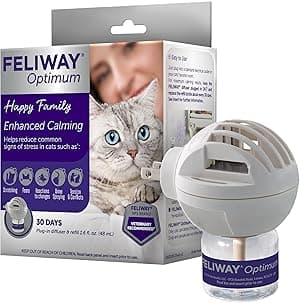
Feliway Optimum, based on feline facial pheromones, is clinically supported for reducing anxiety-related behaviors. Plug it in near your cat's favorite resting area and expect to see gradual improvement over 7-14 days. Full effect typically requires 4 weeks of consistent use.
Schedule 15 Minutes of Daily Play
Interactive play that mimics hunting -- with toys that move unpredictably -- is one of the most effective stress-reduction tools available. Aim for sessions during evening hours (6-9 PM), when cats are naturally more active.
For households where owners work long hours, food puzzle toys let cats self-entertain:
 Interactive Treat Ball / Puzzle Feeder- Works for both cats and dogsAmazonで価格をチェック
 Feather Wand Cat Toy (2-pack)- For hands-on play sessionsAmazonで価格をチェック
Address Heat-Related Stress This Season
As temperatures climb, cats can become irritable and restless from heat stress. Providing a cool resting option they can choose freely makes a real difference:
 YUMOA Aluminum Cat Bowl / Cool Bed- Naturally dissipates body heat without electricityAmazonで価格をチェック
When to See a Vet
Home care has limits. Contact your veterinarian if any of the following apply:
- Weight loss of 5% or more over 2 weeks (e.g., 100g in a 2 kg cat)
- Frequent trips to the litter box with little or no urine output -- this is a medical emergency
- Vomiting 2+ times per day or lasting more than 3 days
- Visible skin due to stress-induced over-grooming
- Complete loss of appetite lasting 24-48 hours
Important: Feline idiopathic cystitis (FIC) -- a common bladder condition -- is primarily stress-driven. Inappropriate urination is often a medical symptom, not a behavioral problem. Don't wait to get it checked.
3 Actions You Can Take Today
- Run through the checklist right now -- Note any items that match your cat's behavior this week. Even one checked box is worth watching.
- Count your litter boxes and water stations -- Make sure you meet the "cats + 1" rule for litter boxes and have water available in at least 2 separate spots.
- Start a 15-minute play session tonight -- Use a wand toy and commit to the same time slot each evening. Most cats show behavioral improvement within 3-5 days.
FAQ
Q1. How quickly do cat stress signs appear after a trigger?
A. Behavioral changes can appear within 24-48 hours of a triggering event. Chronic low-level stress may take 1-2 weeks to become noticeable. Keeping a daily log makes early detection much easier.
Q2. How long does Feliway take to work?
A. Most owners report visible improvement within 7-14 days. For best results, plan for at least 4 weeks of continuous use. Place the diffuser in the room where your cat spends most of their time.
Q3. My home has multiple cats. How does stress management change?
A. Resource competition is the main driver of stress in multi-cat households. Follow the "cats + 1" rule for litter boxes, use separate feeding stations, and provide multiple vertical escape routes. When introducing a new cat, keep them fully separated for at least 2 weeks and introduce scents before visual contact.
Q4. How much does stress management for cats cost?
A. Environmental fixes like reorganizing litter boxes or adding water stations can cost nothing. Feliway runs approximately $25-35 USD per month. A cat tree ranges from $40-200 USD. Start with the free options -- play time and rearranging space -- before investing in products.
Q5. Can stress cause vomiting in cats?
A. Yes. Stress activates the gut-brain axis and can lead to nausea, vomiting, and loose stools. However, vomiting has many causes -- hairballs, overeating, infections -- so if it occurs more than twice a week or contains blood, veterinary evaluation is essential.
Track Cat Stress Signals with PETTAS
One of the most common things I hear from cat owners is: "Something feels different, but I can't remember when it started." That's actually the core problem -- without a record, it's hard to see patterns, and it's hard to give your vet the specifics they need.
PETTAS was built to solve exactly that. With the health timeline feature, you can log daily observations in under 30 seconds. When you visit the vet, instead of "she's been a bit off lately," you can say "over-grooming started 9 days ago, appetite dropped 5 days ago." That context changes the quality of care your cat receives.
You can also share records across family members, so nothing gets missed when multiple people are caring for the same pet.
Start tracking your cat's health with PETTAS
References
- Cornell Feline Health Center -- Comprehensive resource on feline behavior, stress, and idiopathic cystitis
- AAFP Feline Environmental Needs Guidelines (catvets.com) -- Evidence-based standards for indoor cat environment design
- Merck Veterinary Manual – Behavior of Cats -- Clinical reference for psychogenic alopecia, aggression, and inappropriate elimination
- AVMA – Cat Behavior and Enrichment Resources -- Owner-facing guidance on enrichment and stress reduction
- Japan Veterinary Medical Association (nichiju.or.jp) -- Japanese clinical guidelines for companion animal behavioral welfare
Recommended products5 picks
#ad Contains Amazon affiliate links

Pet diary
Track the small changes in your cat's routine
Daily one-tap logs of appetite, weight, and bathroom habits. Spot stress signs earlier and explain them clearly to your vet.
All features free for 14 days — no card required
Get the latest articles by email
Weekly updates on pet health, medications, and insurance — straight to your inbox.
Share this article
Related Articles

7 Indoor Cat Stress Signs in Spring: Subtle Behavior Changes Owners Miss
2026-04-06

7 Early Signs of Cat Kidney Disease: Home Checklist (2026)
2026-05-28

Indoor Cat? 5 Best Cat Foods by Age & Condition (2026)
2026-05-18

Best 5 Cool Mats & Heat Relief Products for Cats in 2026 | Summer Comfort Guide
2026-05-04

Best 5 Cat Grooming Brushes for Shedding Season 2026: Find the Right One for Your Cat
2026-04-26