

3 Causes of Cat Litter Box Avoidance: 5-Step Fix (2026)

PETTAS Editorial Team
Up-to-date pet health guidance
Rainy season humidity makes litter boxes smell worse, triggering avoidance. Fix it in 5 steps: cleaning frequency, box count, odor removal. Read the full guide.
Contents(8)
Last updated: 2026-06-08
Is your cat suddenly eliminating outside the litter box? During humid seasons, even a well-maintained box can become intolerable to a cat's sensitive nose — and litter box avoidance is one of the top behavioral complaints among cat owners worldwide. Studies suggest that 30–40% of indoor cat owners experience inappropriate elimination at some point.
This guide breaks down the 3 root causes, explains why humidity makes things worse, and gives you a concrete 5-step plan to fix it.
3 Root Causes of Cat Litter Box Avoidance
Cause 1: The Box Smells Unacceptable to Your Cat
Cats have a sense of smell estimated to be 200,000 times more sensitive than humans. What smells acceptable to you may be overwhelming to your cat — especially during humid months when ammonia evaporates faster at higher temperatures and moisture levels.
Common owner mistake: Cleaning once a day and assuming that's enough. During humid weather, you may need to scoop after every use. Ammonia buildup happens faster than you think.
Cause 2: Not Enough Boxes, or the Wrong Size
The veterinary standard is one litter box per cat, plus one extra (recommended by both the AVMA and Cornell Feline Health Center). For a single cat, that means 2 boxes minimum. For 3 cats, at least 4 boxes.
Size matters too: the box should be at least 1.5 times the length of your cat (nose to tail base). Too small, and cats may hang over the edge — or just avoid the box altogether.
Easy-to-miss sign: If your cat perches with only front paws inside the box, or bolts immediately after eliminating, these are signs of box discomfort.
Cause 3: Medical Issues or Stress
Sudden onset of inappropriate elimination is often a medical red flag, not a behavior problem. Feline lower urinary tract disease (FLUTD) — including cystitis and urinary stones — can cause cats to associate the litter box with pain and seek other locations.
Seek veterinary care immediately if you notice:
- Frequent trips to the box with little or no output
- Crying or straining during urination
- Blood-tinged urine
- No urination for more than 24 hours (especially in male cats — this is an emergency)
- Accompanying lethargy or vomiting
5-Step Litter Box Fix for Humid Weather
Step 1: Increase Cleaning Frequency
During humid months (roughly June through September), aim to scoop at least twice daily. Replace the entire litter contents every 5–7 days instead of the usual weekly schedule. For sifting or system-style litter boxes, change the absorbing sheet twice a week instead of once.
Step 2: Audit Your Box Count and Placement
Use the checklist below to evaluate your setup:
- Number of boxes = cats + 1
- Each box is in a quiet, low-traffic area
- Boxes are at least 1 meter (3 ft) away from food and water
- At least 2 escape routes near each box
- Boxes in different rooms or floors (not side-by-side — cats see adjacent boxes as one large box)
- Ventilation is adequate to prevent humidity buildup
| Number of Cats | Recommended Boxes | Minimum |
|---|---|---|
| 1 | 2 | 1 |
| 2 | 3 | 2 |
| 3 | 4 | 3 |
| 4 | 5 | 4 |
Step 3: Choose the Right Litter for Humidity
High humidity accelerates bacterial growth in litter, especially in clumping clay. Silica gel and wood pellet litters tend to perform better in humid conditions due to stronger antimicrobial and odor-control properties. When switching litter types, transition gradually over 2 weeks — mix 25% new litter with 75% old, increasing the ratio slowly to avoid rejection.
Step 4: Eliminate Odor at the Source
Cats return to spots that carry their scent. If your cat has already eliminated outside the box, that spot needs to be fully neutralized — not just surface-cleaned.
Standard household cleaners and alcohol sprays cannot break down ammonia at the molecular level. Use an enzyme-based or natural-ingredient cleaner designed specifically for pet urine. Apply generously and let it soak into the surface — don't just spray and wipe.
Here are helpful products for odor control and litter box management:
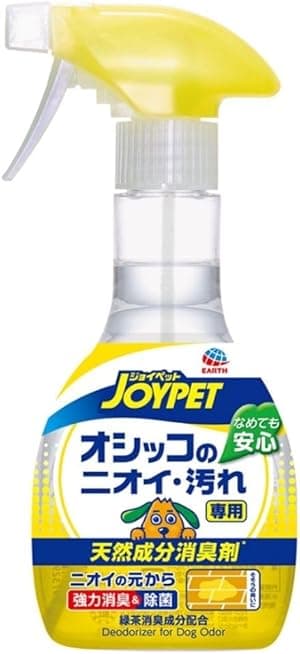 Joy Pet Natural Enzyme Urine Odor & Stain Remover 270mlEnzyme formula that breaks down ammonia in carpets and floorsAmazonで価格をチェック
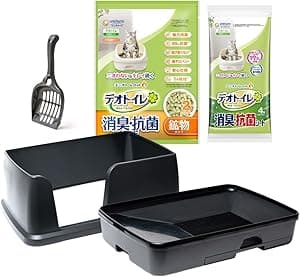 Unicharm Deo-Toilet Wide System Litter Box SetTwo-layer design separates liquid from solid, dramatically reducing odorAmazonで価格をチェック
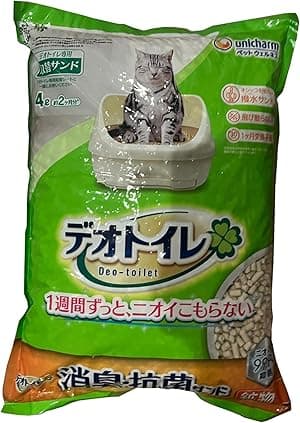 Unicharm Deo-Toilet Antibacterial & Deodorizing Sand 4LAntimicrobial litter suited for humid conditionsAmazonで価格をチェック
Step 5: Reduce Stress With Pheromone Diffusers
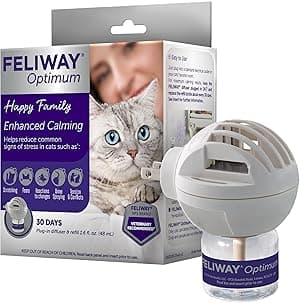
If litter box avoidance appears linked to stress — changes in household routine, new pets, construction noise — synthetic feline facial pheromone products can help cats feel more secure in their environment. Plug-in diffusers cover a typical room and work continuously for about 30 days.
Multi-Cat Households: Extra Rules That Apply
In multi-cat homes, litter box conflict is one of the most common sources of inappropriate elimination. Cats are territorial, and one cat may "guard" a box to block access to others.
Key rules for multi-cat setups:
- Place boxes in separate rooms, not grouped together
- Ensure the "submissive" cat always has a box it can access without passing the dominant cat's territory
- Perform a full litter replacement monthly to reset scent markers
- Observe each cat's litter box usage — a sudden change in frequency or duration is often the earliest sign of a health issue
When to See a Vet
Environmental fixes won't solve a medical problem. Always rule out physical causes before assuming behavior is the issue. Urethral obstruction in male cats — where urine cannot pass at all — is a life-threatening emergency requiring treatment within hours. If your cat has not urinated in 24 hours, go to an emergency clinic immediately.
3 Actions You Can Take Today
- Scoop the litter box tonight and note the smell and clumping quality — this tells you immediately whether you need to change the litter or increase frequency
- Count your boxes and check placement — does every cat have unobstructed, stress-free access to at least one box?
- Spray any existing accident sites with an enzyme-based cleaner to remove the scent map that's directing your cat back to the wrong spot
Track Your Cat's Litter Box Habits with PETTAS
One of the most useful things you can do for a cat with litter box issues is keep a simple log: when did the problem start? Did it improve after the litter change? What did the vet find on the last visit?
That's exactly why I built PETTAS — a pet health app where you can track health timelines, share records with family members, and set reminders for medication or vet follow-ups. When you can show a vet a clear timeline of when symptoms started and what you've tried, the diagnostic process gets faster and more accurate.
Start tracking your cat's health → https://pettas.tech/?utm_source=blog&utm_medium=article&utm_campaign=rainy-season-cat-toilet-failure-causes-solutions-2026
FAQ
Q1. How often should I clean my cat's litter box?
A. Scoop at least twice daily, and replace the full litter contents every 5–7 days. During humid months, daily full replacement may be needed if odor increases quickly. System-style boxes with absorbent sheets should have sheets changed twice weekly in summer.
Q2. How many litter boxes does a cat need?
A. The veterinary standard is one box per cat plus one extra. For a single cat, that's 2 boxes; for 3 cats, at least 4. Place them in different locations — not side by side — so each box functions as a distinct toilet option.
Q3. My cat started missing the box suddenly. Should I call a vet?
A. Yes — sudden onset inappropriate elimination should be evaluated by a veterinarian before assuming it's behavioral. Feline lower urinary tract disease (FLUTD) is a common underlying cause. Male cats with no urine output for over 24 hours need emergency care immediately.
Q4. Why does litter box odor worsen in humid weather?
A. Higher temperature and humidity accelerate ammonia evaporation from urine and promote bacterial growth in litter. The same cleaning routine that works in winter may be insufficient from June through September. Increase cleaning frequency and consider switching to a litter with stronger antimicrobial properties.
Q5. Will my cat keep eliminating in the same wrong spot?
A. Yes, unless the scent is fully removed. Cats use urine scent to identify "approved" elimination sites. Standard cleaners don't break down ammonia molecules, so the smell remains detectable to your cat even after you think it's clean. Use an enzyme-based cleaner and allow it to soak into the surface rather than just wiping it away.
References
- Cornell Feline Health Center — Litter Box Problems — Feline elimination behavior, FLUTD, and environmental management
- American Veterinary Medical Association (AVMA) — Cat Behavior Resources — Litter box count recommendations and multi-cat household guidelines
- Merck Veterinary Manual — Inappropriate Elimination in Cats — Medical and behavioral classification of feline inappropriate elimination
- American Association of Feline Practitioners (AAFP) — Feline Environmental Needs Guidelines — Evidence-based recommendations for indoor cat environment including litter box setup
- Japan Veterinary Medical Association — Survey data on common cat behavioral health concerns in Japan
Recommended products4 picks
#ad Contains Amazon affiliate links
Pet diary
Track the small changes in your cat's routine
Daily one-tap logs of appetite, weight, and bathroom habits. Spot stress signs earlier and explain them clearly to your vet.
All features free for 14 days — no card required
Get the latest articles by email
Weekly updates on pet health, medications, and insurance — straight to your inbox.
Share this article
Related Articles

5 Steps: Fix Indoor Cat Boredom in Rainy Season (2026)
2026-06-07
5 Vet-Approved Tips: Multi-Cat Intro During Rainy Season (2026)
2026-06-06

5 Steps: Raise a Kitten in Rainy Season Safely (2026)
2026-06-05
5 Best Grooming Tools for Cat Shedding Season (2026)
2026-06-03
5 Ways to Cool Indoor Cats and Prevent Heatstroke (2026)
2026-05-31